
10 Things You Need to Know About Handfasting Ceremonies

Handfasting ceremonies are one of those things that divide people into two camps: those who have never heard of them, and those who are absolutely obsessed! If you’re reading this, you’re probably somewhere in between – curious, maybe a little intrigued, and wondering whether it could work for your ceremony.
Handfasting ceremonies are a simple yet profound way to honour your commitment and love.
As a celebrant who has officiated everything from full pagan handfasting ceremonies complete with the four elements and a sacred circle, to couples who simply want their hands tied together while they say their vows, I can tell you it is one of the most versatile and meaningful rituals you can include in a ceremony.
1. Handfasting Ceremonies are One of the Oldest Wedding Traditions
An ancient ritual, handfasting ceremonies go back centuries. It was practised across Celtic and Norse cultures throughout Britain, Ireland and Scandinavia long before church or civil marriages ever existed. The word comes from the Old Norse “handfesta,” meaning to strike a bargain by joining hands, which is essentially what it was: quite literally a binding commitment.
In rural communities where the church wasn’t always accessible, handfasting served as a recognised form of betrothal or marriage. Sometimes it was a trial union for a year and a day, after which couples could choose to make it permanent or walk away. It was practical, and it was taken seriously.
2. Understanding Handfasting Ceremonies
When formal marriage became more regulated by the church, handfasting gradually disappeared from mainstream practices. But it never completely vanished. Pagan communities continued to honour it as a sacred spiritual rite, keeping the tradition alive through generations when it might otherwise have been lost for good. It’s thanks to those communities that we have such a rich body of knowledge around the symbolism, the cords, the knots and the ritual itself. And it’s why, when you go looking for information on handfasting, you’ll often find a beautiful mix of ancient tradition and a modern practice.
3. “Tying the Knot”
Every time someone says they’re tying the knot, they are (probably without knowing it) referencing a handfasting. The cords or ribbons bound around the couple’s hands during the ceremony are the knot. The act of binding is the act of committing and it’s where the term ‘tie the know’ comes from. I love this. Language carrying ceremony forward without anyone realising!
4. As Spiritual or as Simple as You Want
This is the thing I most want couples to understand. Handfasting is not one fixed thing. It is a spectrum.
At one end, you have a full pagan ceremony: a sacred circle is cast, the four directions are called, the elements of earth, air, fire and water are represented, and the handfasting is woven into a ritual with spiritual depth and intentionality. I’ve officiated ceremonies like this and they are deeply moving – you feel weight of ancient history in the room!
At the other end, you have couples who simply want their hands tied together for a moment during their ceremony because they love the symbolism of it. No spiritual element, no ancient words, just a symbolic ritual that anchors their vows.
In between there are all sorts of variations. Couples who want the ritual without the religion. Couples who want one foot in the traditional and one in the contemporary. Whatever you’re drawn to, there’s a version of handfasting that fits.
5. Symbolic Cords
Choosing your cords, ribbons or fabric is one of the most personal parts of planning a handfasting, and one of my favourite conversations to have with couples. Different colours and materials carry different meanings, though it’s worth noting that traditions vary and ultimately you should choose what resonates with you.
Tilly and Lewis incorporated fabric from Tillys late Mum into their Handfasting making the moment deeply deeply emotional. And Georgia and Sam used two pieces of specially chosen fabric to symbolise the joining of their two surnames into one.
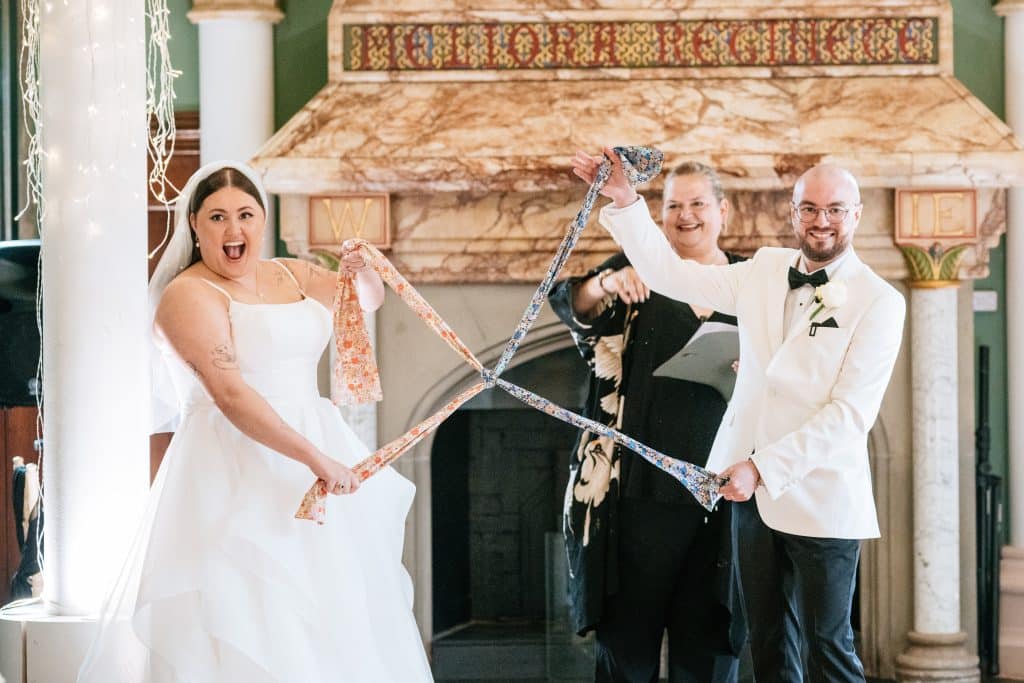

Different colours also carry different meanings. Here are just a few ideas:
- Red: passion, strength, love.
- White or silver: new beginnings, clarity, purity.
- Green: growth, abundance, and connection to the natural world.
- Blue: loyalty, trust, deep friendship.
- Gold: wisdom, prosperity, warmth.
- Purple: spirituality, intuition, honouring the sacred.
- Black: protection, strength, banishing negativity.
I’ve had couples choose colours from their wedding palette with no symbolic intention whatsoever, and that’s just as valid. It’s your ceremony.
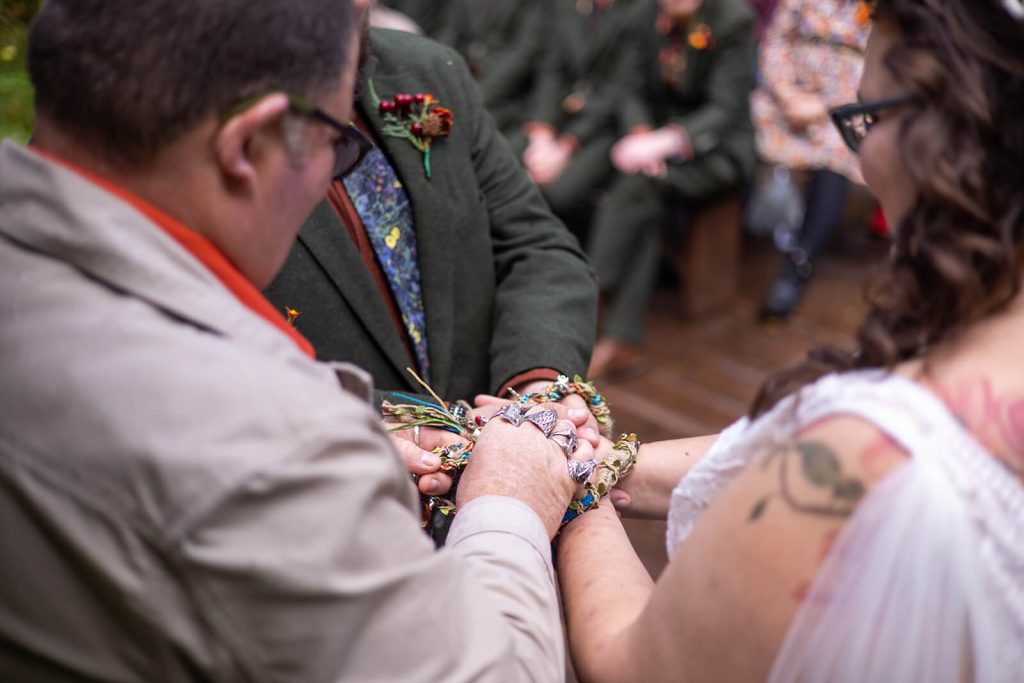
When Carrie and Charlie were hand fasted they used a cord they had created together including charms, rope, ribbons and colours that were deeply meaningful and personal to them and their story.
6. Different Ways to Tie the Knot
How the hands are bound is just as intentional as what colour the cords are. There are a number of different configurations, each with their own meaning.
The simplest is a straightforward wrap, where the cord is laid across both hands and the ends brought together. Clean, clear and very visual, especially when multiple cords are used at once.
The infinity knot, creating a figure of eight around both hands, is a popular choice and symbolises the continuous, unbroken nature of the commitment. It looks stunning and photographs beautifully.
Some ceremonies involve a knot being tied with purpose, each wrap of the cord representing something specific: the past and the future, what you bring individually and what you create together, or the promises being made in that moment.
And many handfastings, the binding is done not by the celebrant but by family and friends. As a celebrant I’m always looking for ways to make ceremonies even more personal and the participation of family and friends is one of my favourite ways!

Most couples choose two or three cords rather than one, but some go further and lay 20+ cords! When Matt and Denry got married last year they had 18 ribbons laid in 9 pairs by their family and friends. Each pair represented a quality they promised to model in their marriage.
7. The Vows You Say
The words spoken while the hands are bound can be traditional, modern, spiritual, funny, or a complete mix of all of the above. There is no rule here.
I’ve had couples recite ancient Celtic blessings in the original Gaelic. I’ve had couples write their own words from scratch that made the entire room laugh and cry. I’ve had couples make one-line commitments that were so simple and so specific to their relationship that they hit harder than any reading could.
8. The Cord Stays With You
The cords used in a handfasting aren’t discarded after the ceremony, they go home with the you.
Some people frame them. Some keep them on an altar. Some tuck them into a memory box alongside other mementos from the day. Whatever you do with them, they become an object that carries the energy and intention of that moment. A physical reminder of the commitment you made and the ritual that sealed it.
9. No Two Handfasting Ceremonies Are the Same
Even if two couples used identical cords, identical words and identical knots, the ceremonies would feel completely different. Because the people in them are different.
The setting changes everything. A handfasting in a woodland feels nothing like one on a beach or in a barn. The energy of the guests in the space matters. All of it shapes the experience.
This is one of my favourite things about being a celebrant. I’ve done lots of handfastings and each one has been different making tremendous scope for creativity too!
Handfasting ceremonies can truly enrich your wedding day experience.
10. See Exactly How It’s Done
If you’re a visual person and you want to actually see what the hand tying part of a handfasting looks like in practice, you are in luck. Over on The Celebrant Sisters YouTube channel, we’ve put together a video showing a few different ways to tie the knot. Whether you’re a couple trying to picture it for your own day, or a friend or family member swotting up on how to tie the knot in practice, it’s well worth a watch.
The Celebrant Sisters is a YouTube channel for couples and families who want real, practical, no-fluff guidance on planning personalised ceremonies. We cover everything from handfasting to writing your own vows, and we’re adding new videos all the time. Watch, like and subscribe so you don’t miss anything.
Handfasting is ancient, it’s adaptable, and when it’s done well it is one of the most moving things you can witness at a ceremony.
If you’re thinking about including it in yours and want to talk through what that could look like, I’d love to hear from you!
Share the love